
A New Course: Enhancing Your Workflow with AI
By Ben Jones, Co-Founder and CEO of Data Literacy
I use generative AI in my own workflows every day – mostly Claude. I also spend a lot of time noticing where it fails. I created this course to help people deal with that reality.
If you've ever tried to use AI at work, you've probably noticed that sometimes, you can ask AI to do something for you, and it comes back nice and sharp, taking way less time than if you had done it yourself. Other times you hand it a different but similar task, and it comes back sounding just as confident...only it's wrong, or flawed in some major way.
That's the jagged technological frontier: the irregular boundary between the work where AI helps you and the work where it hurts you. It zigzags. Two tasks that look alike to us can sit on opposite sides of the border, and you can't always tell in advance which side you're on. It's the terrain most of us are working on now.
I'll tell you up front where I stand. I'm not an AI skeptic, and I'm not an evangelist. I've been genuinely impressed by what these tools can do. I've also watched what happens to a person's judgment when they stop bringing their own thinking to the work, and that's the trap I most want to help people avoid. The people I've seen get the most out of AI are the ones who never stopped valuing their own creativity, their own read on nuance, their own feel for context. This course is my best attempt to teach that balance.
Enhancing Your Workflow with AI is live today at dataliteracy.com/courses/enhancing-your-workflow-with-ai. It's the first course in our new Practical AI series, with more on the way, including Analyzing Data with AI. To take it on your own, you'll want a Plus subscription, which includes our on-demand course library. Pro adds the AI Coach and AI Tutor, useful if you want a study partner as you work through the lessons.
What it teaches
There isn't a single trick for staying on the right side of the frontier. There are several, and the course teaches them one at a time.
There's automation bias, the human tendency to treat a machine-generated answer as more accurate and complete than it is. It's a quiet drag on quality, and most professionals don't realize it's happening to them.
There's voice validation for anyone using AI to help write. Read the output aloud, and change anything you would never have said. It's the difference between AI-assisted writing that still sounds like you and AI-assisted writing that sounds like everyone else using AI.
There's a three-layer validation hierarchy for judging AI research output, so that "check it" is a habit with an actual shape, not a vague intention.
There's the Human Agency Scale from Stanford. It runs from H1 to H5 and gives you a way to ask, for any given task, how much human involvement the work actually warrants. Sometimes the answer is "very little." Sometimes it's "a lot," and that's the answer we tend to miss.
There's work on pathways to non-reliance, the research term for the routes by which a person correctly decides not to go along with what the AI produced. Preserving those routes is a real skill.
And there's plain talk about skill atrophy and overconfidence. If you speed up on something you used to be able to do without the tool, and then you stop being able to do it without the tool, you've become dependent, and you might come to regret that one day down the road.
The structure
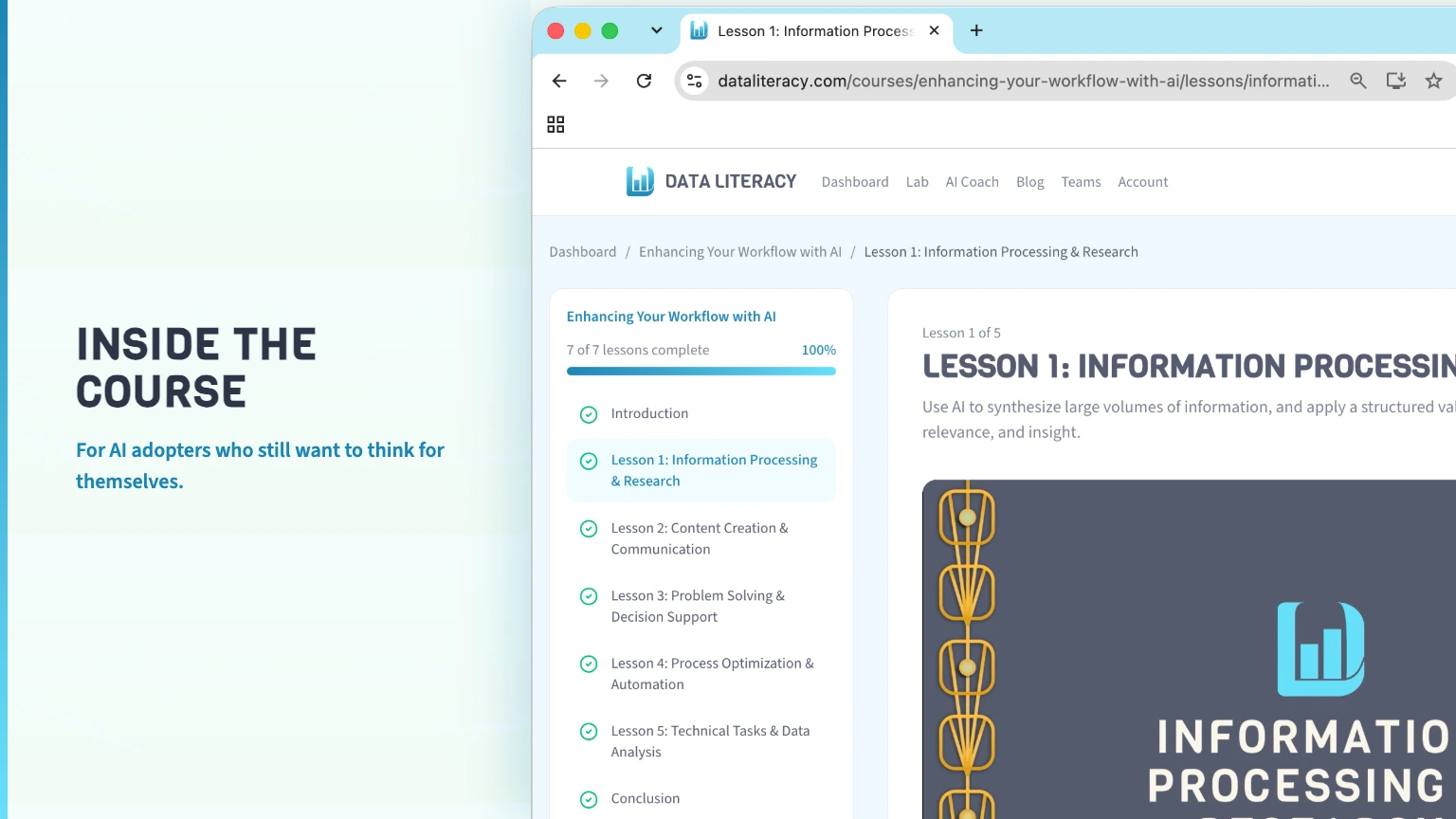
The course has an introduction, five topic lessons for the kinds of knowledge work most professionals actually spend their days on, and a conclusion. The five lessons are Information Processing & Research; Content Creation & Communication; Problem Solving & Decision Support; Process Optimization & Automation; and Technical Tasks & Data Analysis. 18 in-lesson knowledge checks and 60 quiz questions across the course, plus prompt templates you can copy and adapt. Finish the lessons and pass the quizzes, and you earn the AI Practitioner badge.
Bringing it to your team
The course works well on your own. It works even better as the anchor for a live workshop I can deliver for your team, virtual or in-person. When we run it that way, everyone on the team also gets access to the on-demand course as part of the workshop package, so they can revisit any of it after the sessions end.
I just wrapped two days of this workshop with a client team. One of the participants wrote afterward to say the sessions were "educational, conversational, and completely collaborative," and that even seasoned AI users on the team came away with features, benefits, and business applications they hadn't come across before. Those are the workshops I love to run.
Two ways in
If you're taking it on your own, subscribe to Plus or Pro and start the course today.
If you want to bring it to your team, tell me a bit about your group and I'll get back to you personally about a live workshop.
If you take the course, tell me what worked and what didn't. That's how we make it better.
Enjoyed this post?
Get new posts and practical ideas for working with data and AI in your inbox.
Training your team on this?
Live workshops led by Ben Jones and on-demand courses with an AI Coach, for teams of 10 or more.
See team training optionsKeep learning
Explore the full library of data and AI literacy courses, with an AI Coach to guide you.
Browse courses