
Choosing a Data & AI Literacy Training Program: A Buyer's Guide for L&D Leaders
Most organizations now agree their people need to get better with data and AI. But not everyone agrees on exactly what a good training program looks like. Sure, you can buy a whole library of courses, announce it, and report a halfway decent enrollment number a quarter later. It's much harder to change how people actually read a dashboard, question a forecast, or decide when to trust an AI-generated answer.
After almost a decade of designing and delivering data literacy training for companies, universities, and government agencies, I've found that the programs that work share a fairly common set of elements. The programs that fail are usually missing at least a few of them.
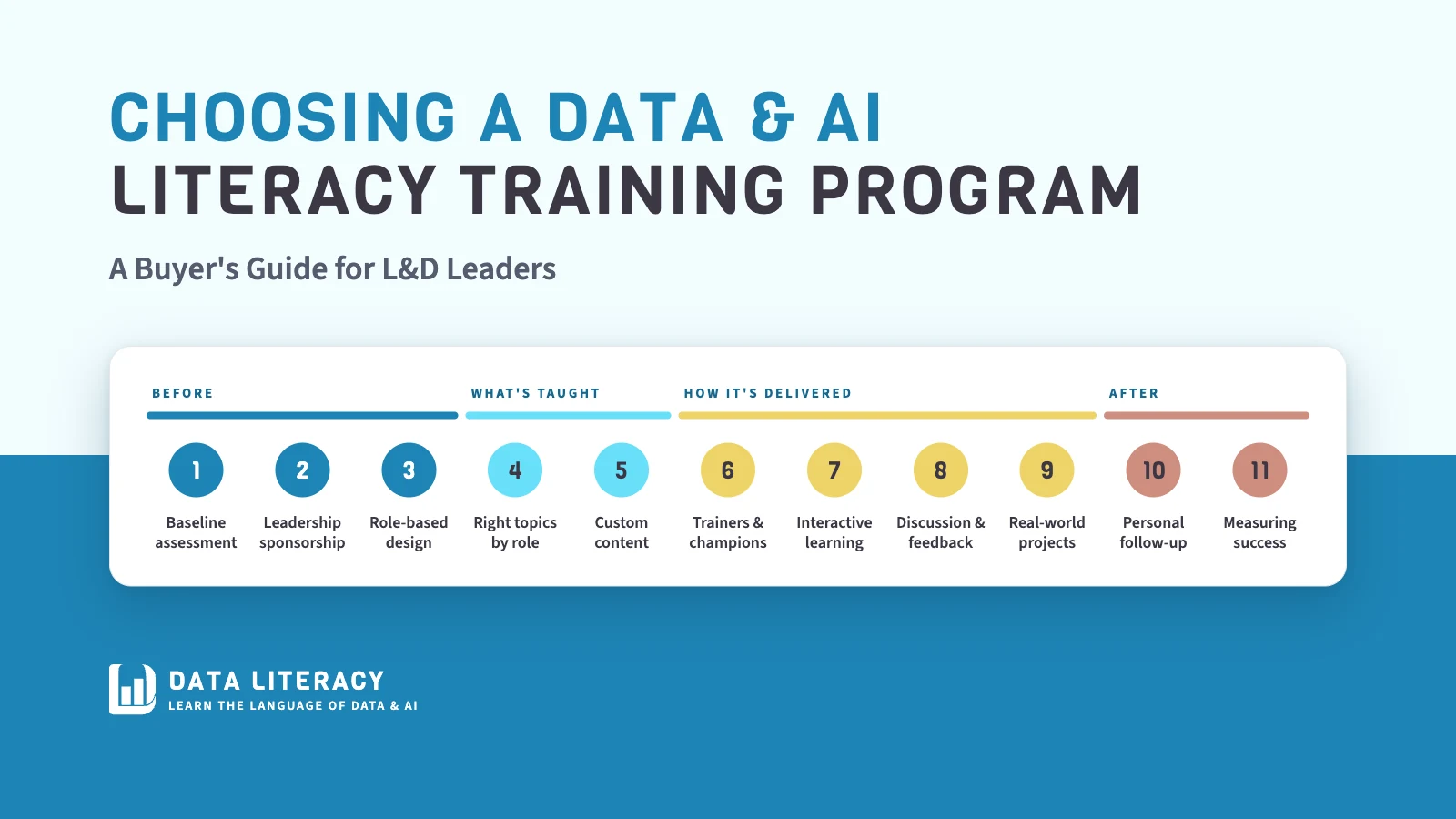
Here are the 11 elements I'd look for, grouped by when they matter: before, during, and after training. For each, you'll find why it matters, what good looks like, and a question to ask any provider you're considering, including us.
Before training
1. A baseline assessment
You can't improve what you haven't measured, and you can't design the right program without knowing where people start. A good baseline captures two different things:
- How people think and feel about data and AI: their confidence, their attitudes, how often they use these tools, and where they feel stuck.
- What they can actually do: whether they can correctly read a chart, spot a misleading statistic, or judge an AI output.
Those two elements, the subjective and the objective, can often disagree. Teams that feel confident sometimes score poorly on the objective questions, and the gap between the two is one of the most useful findings for leadership.
Ask the provider: How will you measure where our people are starting from, both what they believe and what they can demonstrate?
2. Visible leadership sponsorship
Data literacy programs stall when leaders approve the budget and then disappear. People take their cues from what leaders ask for in meetings, which reports they trust, and whether they model curiosity about the numbers. The strongest programs give leaders their own learning track, so they can lead the change rather than just fund it.
Ask the provider: What do you offer specifically for executives and people managers, and how do you involve them in the program?
3. Role-based design, not one-size-fits-all
A financial analyst, a frontline supervisor, and a marketing director don't need the same training. One-size-fits-all programs bore the advanced learners and overwhelm the beginners. Good programs define a small number of personas based on how people actually use data and AI in their jobs, then shape each learning path around them.
The best way to define those personas is with data: a short survey of how employees use data and AI today, and how comfortable they are doing it.
Ask the provider: How do you decide which roles or personas need which training, and what data do you base that on?
What's taught
4. The right topics for each role
This used to be the hard part. Today, with AI able to draft a reasonable curriculum outline in seconds, it's the easy part. Lists of topics are everywhere. It's up to you, though, to figure out which concepts each role truly needs, in what order, and at what depth.
Look for providers whose topic frameworks come from real expertise and real classrooms, not just a generic outline.
Ask the provider: Where does your curriculum come from, and how do you adapt it for different roles?
5. Customized to your organization's data and scenarios
People learn faster when the examples are about their own work. A program built on your organization's real (or sanitized) data, dashboards, case studies, and decisions transfers to the job far better than one built on generic sample datasets.
Customization should also extend to delivery. Some organizations want learners on a provider's platform; others need courses inside their own learning management system.
Ask the provider: Can you build exercises and examples around our data and scenarios, and can the courses run inside our own LMS?
How it's delivered
6. Enthusiastic, credible trainers and internal champions
Learners can tell within minutes whether an instructor genuinely knows the subject and genuinely cares whether they learn it. Credibility comes from real-world experience; energy comes from caring about the subject and the learner. The best trainer is going to have both of these traits.
And remember to think beyond the trainer. Over time, the best programs also develop internal champions: people inside your organization who carry the work forward after the trainers leave.
Ask the provider: Who will actually teach our people, what's their background, and how will you help us build internal champions?
7. Engaging, interactive learning
Passive video and long lectures produce completion certificates, not capability. Look for live polls and quizzes, short challenges, breakout discussions, Q&A, and learners presenting their own work to the group. I don't know about you, but I've certainly found that adult learners want to be an active part of their learning experience.
Ask the provider: What does a typical session actually look like, minute by minute?
8. Discussion and feedback
People improve when someone looks at their work and tells them what to do differently. That means office hours, detailed feedback on submitted work, and room for discussion with peers. Adult learners don't just want to listen to a lecture. They want to share at least as much as they listen.
Ask the provider: How and when will learners get feedback on their own work, and from whom?
9. Real-world projects, done during the program
The most common failure in training is the gap between the course and the job. The fix is a course project that learners apply to their own work while they're learning, not after they finish. "How are you using this right now?" is a far more powerful question than "How will you use this someday?"
Ask the provider: Does every course include a project tied to the learner's real work, and when does it happen?
After training
10. Ongoing reinforcement, not a one-off workshop
A single workshop, however good, fades within weeks without reinforcement. Look for follow-up sessions where participants share how they've applied what they learned, ongoing access to on-demand material, and hands-on mentoring for people working on real projects.
Ask the provider: What happens after the training ends, and for how long?
11. Measuring success well beyond enrollments and completions
Enrollment and completion rates tell you people showed up. They don't tell you whether anything changed. Strong programs measure:
- Change in literacy: the same baseline assessment, taken again after the program.
- Learning: knowledge checks before and after each course.
- Satisfaction: Net Promoter Score and feedback from participants.
- Behavior and outcomes: whether people are using what they learned, such as questioning a chart before acting on it, building better dashboards, or using AI tools with appropriate skepticism.
Ask the provider: Beyond completion rates, what will you measure, and how will you show us what changed?
A quick checklist
Tick off each element as you evaluate a provider.
How Data Literacy approaches each element
I'd encourage you to use the questions above with every provider you talk to. Here's how we answer them.
- Baseline: Our Data & AI Literacy Score is a team-based assessment with both a subjective section (how people think and feel about data and AI) and an objective section (whether they can get the answers right), so leadership gets a multi-faceted view of where things stand.
- Leadership: Our Data Literacy for Leaders program pairs with my book Leading in the Age of Data, and our library now includes Patrick McGarry's The Adaptive Organization, a leader's guide to thriving in the AI era. See the books.
- Role-based design: We define personas with data, helping you design an employee survey on data and AI usage and comfort.
- Topics: We've offered dedicated data literacy training since 2018 and dedicated AI literacy training since 2023, and you'd be hard pressed to find anyone who started earlier. Along with the books Data Literacy Fundamentals and AI Literacy Fundamentals, that work has helped define what these topics include.
- Customization: We incorporate your organization's actual or sanitized data and real case studies, either in custom versions of our on-demand courses or in the exercises and examples in live sessions. Learners can use our platform, or yours through SCORM.
- Trainers: This is what I do best. I care deeply about the subject and about the learner's experience, and that comes through in every session I run.
- Interactive learning: Live polls and quizzes, short challenges, breakout discussions, Q&A, and participants presenting their work to the group.
- Feedback: Office hours and detailed feedback on submitted work.
- Projects: Courses include a project that asks how you're applying what you're learning right now.
- Reinforcement: Follow-up sessions where participants share how they've applied what they learned, and hands-on 1:1 mentoring on real projects, such as helping participants improve their own Power BI dashboards.
- Measurement: The Data & AI Literacy Score before and after, knowledge checks before and after, and Net Promoter Score from satisfaction surveys.
On-demand learners can also use our optional AI Coach and AI Tutor between sessions. For organizations that prefer not to use AI features, we offer a version of the courses without them. The approach we've seen work best is human plus AI: a credible human trainer leading the program, with AI helping each person keep going in between.
See training options for your organization
If you're planning a program and want a second opinion, grab 30 minutes on my calendar. I'm happy to talk it through, even if we're not the right fit.
Enjoyed this post?
Get new posts and practical ideas for working with data and AI in your inbox.
Training your team on this?
Live workshops led by Ben Jones and on-demand courses with an AI Coach, for teams of 10 or more.
See team training optionsKeep learning
Explore the full library of data and AI literacy courses, with an AI Coach to guide you.
Browse courses