
Your Data Doesn't Have to Be Perfect to Start with AI: Data Foundations for AI Comes to Data Literacy
By Ben Jones, Co-Founder and CEO of Data Literacy
In all my years of working with organizations on data, I've never seen a perfect data environment.
Every organization I've worked with has a few systems that don't quite talk to each other. There's always a table or two that nobody fully understands (and the one person who did left in 2019). And there are always a few numbers that people quietly double-check before they put them in a slide deck. That's just what data looks like in the real world.
So when people ask me whether they should hold off on AI until they've cleaned all of that up, my answer is no. Please don't wait. You'd be waiting a very long time.
What would I suggest instead? Start with the work where your data is already in decent shape. Learn as you go. And improve the foundations underneath as you build. Readiness is something you keep improving, a little at a time, and AI can actually help with the improving. It's surprisingly good at drafting documentation for tables nobody ever described, at flagging inconsistent or duplicate records, and at suggesting definitions for terms that mean different things to different teams.
The trick is knowing where to focus first. Which improvements would make the biggest difference for what you want AI to do? That's the question we built Data Foundations for AI to help answer.
A little backstory
Earlier this year, I built Data Foundations for AI as a free web app on its own site, df4ai.com. Some of you may remember my post about it. Our clients kept asking how to improve their data and infrastructure so they could get the most out of AI, and I wanted a better way to help them think it through than a basic survey. (I built it with Claude Code, and the wonderful icons were drawn by the talented Alli Torban.)
At the end of that post, I mentioned a few ideas for where it could go next, including "multi-respondent team assessments" and "eCommerce."
Today, Data Foundations for AI moves to dataliteracy.com, alongside our courses and team assessments. And it now comes with a team version you can buy online, called the Data Foundations Score. More on that below.
What the assessment looks at
It asks 30 questions across five foundations that shape how well AI works with your data:
- Data Architecture & Accessibility: how data is stored, integrated, and reached
- Data Quality & Trust: whether the data is complete, accurate, consistent, and current
- Data Governance & Stewardship: ownership, policies, privacy, and lineage
- Data Documentation & Metadata: whether people (and AI) can tell what the data means
- Data Literacy & Culture: whether people know how to use data well, and actually do
Every question works the same way. You read five statements, Level 1 through Level 5, and pick the one that sounds most like your organization today. Each statement describes what that level actually looks like in practice, so you're matching your organization to something concrete.
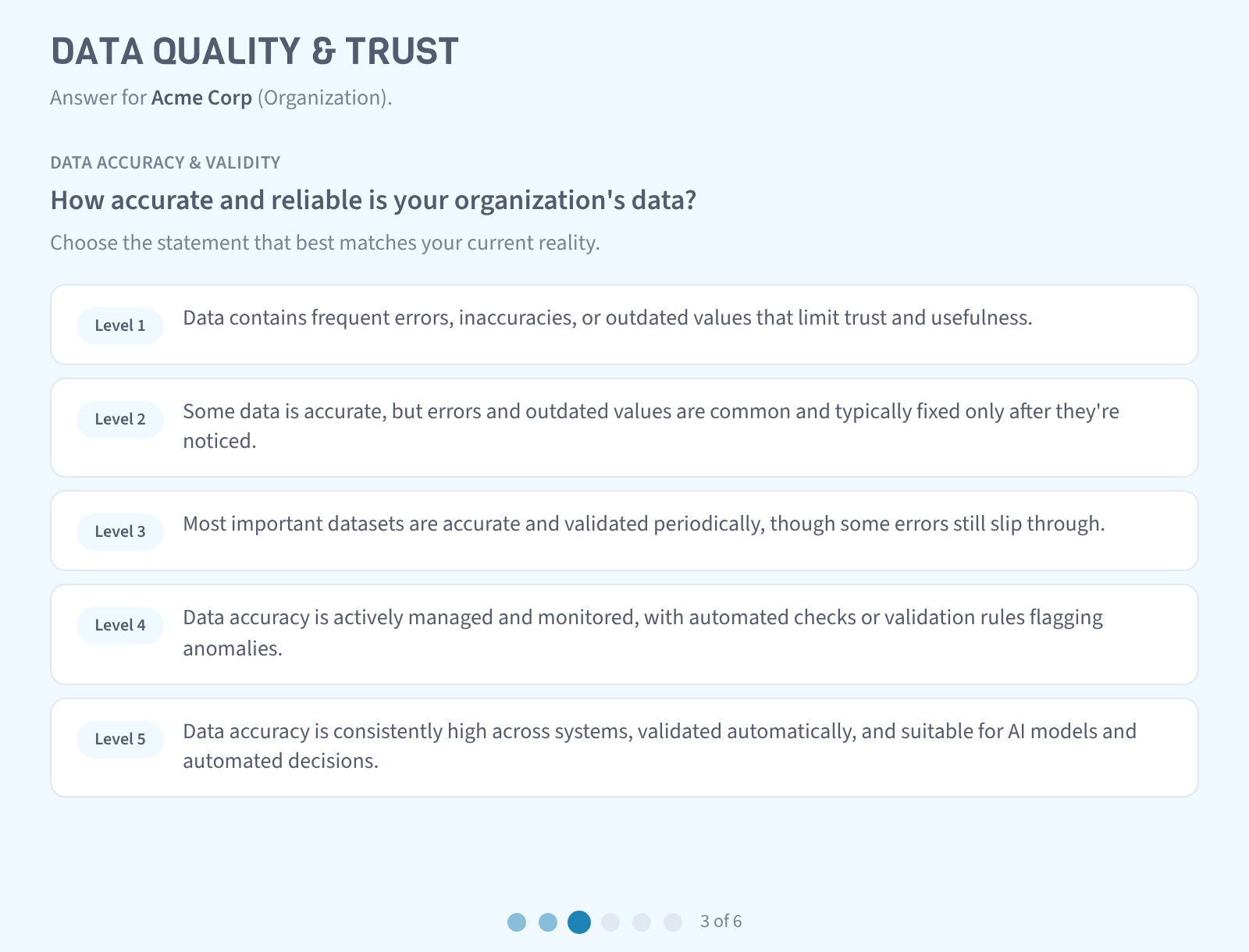
Each question describes five levels in plain terms. You choose the one that sounds most like your organization today.
It takes 10 to 15 minutes. When you finish, you get an overall score from 1 to 5, placed on one of five maturity levels (Foundational, Emerging, Developing, Mature, or Leading). You also get a score for each of the five foundations, and a short list of where you're strongest and where improvement would help most.
There's no passing grade. Wherever you land, AI has useful work it can do with your data today. Your results show you what's working, where you're likely to hit some friction, and which next steps would pay off fastest.
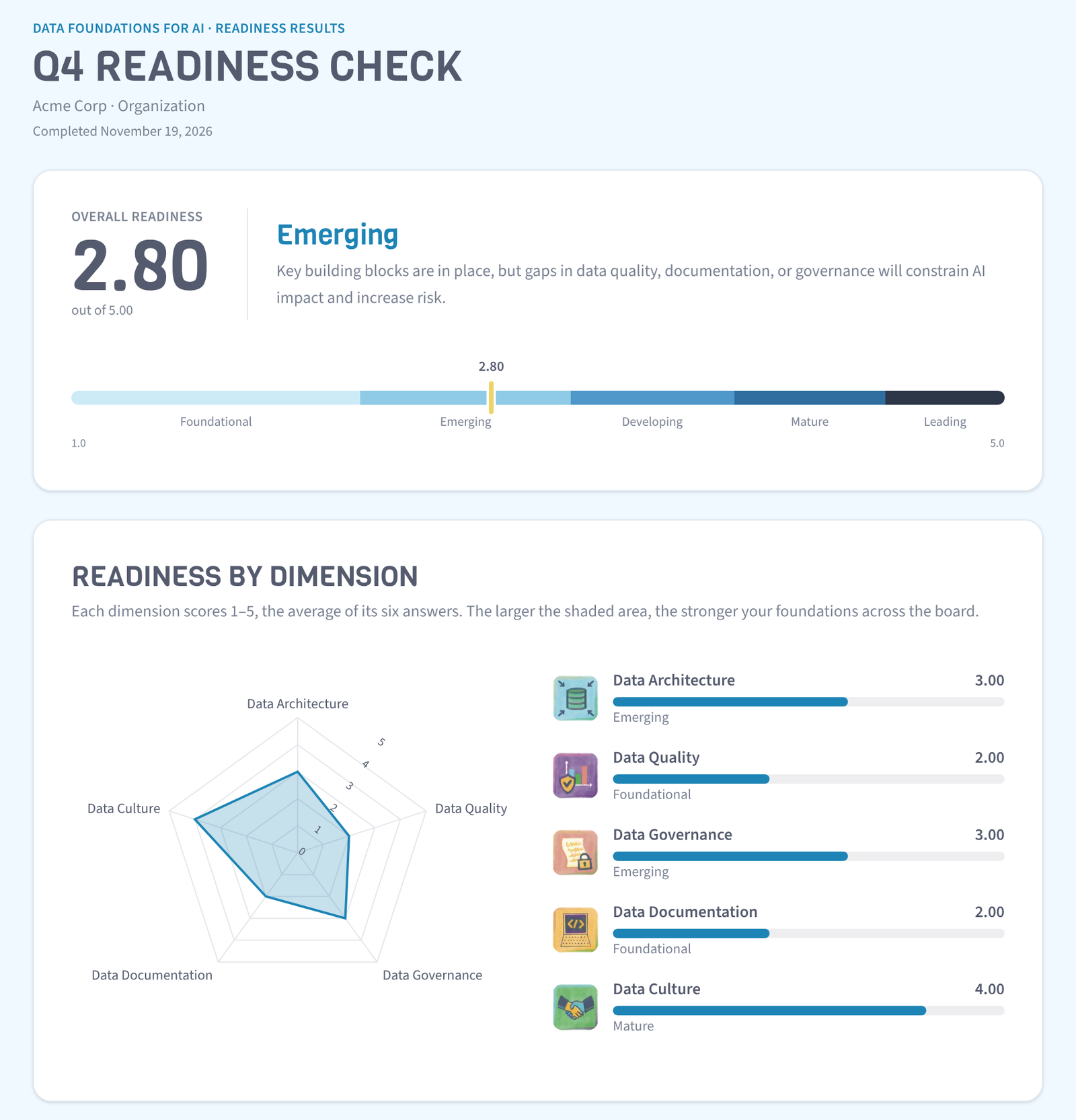
Example results from made-up answers, not a real organization.
You can save the report as a PDF to share with your leadership team, download your answers as a CSV, and take it again in a few months to see how far you've come. It's free. All you need is a Data Literacy account, so your results have somewhere to live.
Took it on df4ai.com before?
Good news: your results came with it. Every assessment taken on df4ai.com, finished or not, has been moved over. Sign in to dataliteracy.com (or create a free account) with the same email address you used on df4ai.com, and you'll find them under Account › Readiness assessments. Old df4ai.com links will bring you here, too.
New: the Data Foundations Score, for your whole team
A self-assessment gives you one person's view. And one person rarely sees everything.
Put a data engineer, a BI analyst, and a business leader in the same room and ask them how good the data is. I'd bet you'll hear three different stories. Who's right? Probably all of them, at least partly. They're each looking at a different part of the same elephant.
The Data Foundations Score sends the same 30 questions to everyone who works with your data, through one anonymous link. You choose what it covers (your whole organization, a department, a single team), and every question gets worded for it. Nobody signs in, and nobody's individual answers are ever shown.
When it closes, you get a leadership report built from everyone's answers: your team's overall score, each of the five foundations, and your strongest areas along with the ones where improvement would help most.
My favorite part of the report, by far, is a section called "Where your team disagrees." It lists the questions with the widest spread of answers.
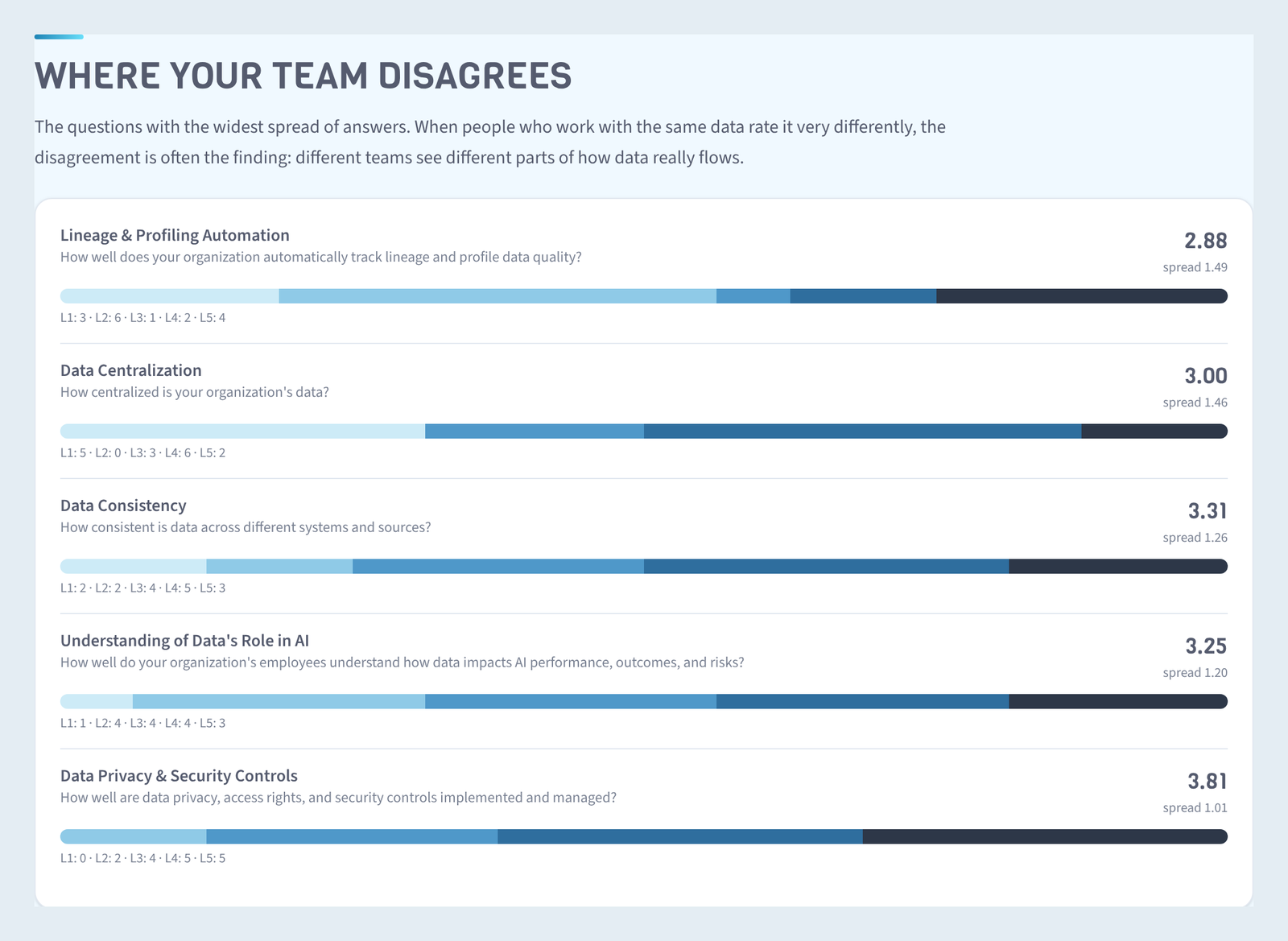
From an example report built from made-up responses.
When people who work with the same data rate it very differently, that disagreement is usually telling you something important. Different groups see different parts of how the data really flows. Those are great conversations to have early, before you scale up an AI project.
You can also break the results down by role, team, or region. Do your data folks and your business folks describe the same organization? Now you'll know.
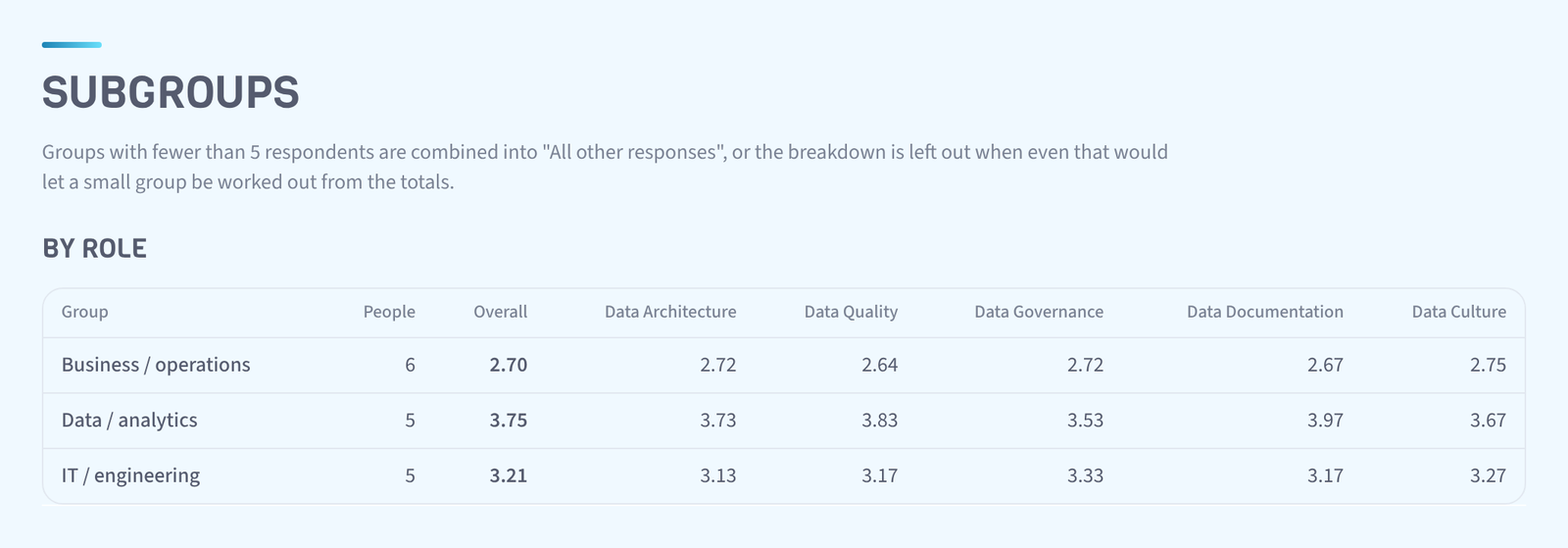
Any group smaller than five people is combined with others or left out, so nobody's answers can be picked out.
Becoming an AI-powered organization is a technical change and a cultural one, and it happens a step at a time. Run the Data Foundations Score once to see where you're starting from. Then run it again a few months later to see what your improvements have moved.
Pricing
One price covers the whole team, based on how many people take part:
- Up to 10 people: $750
- 11 to 25 people: $1,250
- 26 to 100 people: $2,500
For more than 100 people, or if you'd rather pay by invoice, request a quote.
You can also add an expert review at checkout. I'll read your team's results myself, write recommendations into your report, and then walk your leadership through them on a readout call, including where AI can start helping right away. It's $2,500, $3,000, or $4,000, depending on team size.
And if you'd like us to run the whole thing for you, our facilitated Readiness Diagnostic is still available. We interview your data, IT, and BI leaders, sort out where they disagree, and deliver an executive readout.
Get started
I'd suggest taking the free self-assessment first to get your own read on where things stand and where to focus. Then bring in your team when you're ready.
Get started with Data Foundations for AI
If you'd like to talk through which option fits your organization, get in touch. I'd love to hear what you're planning to do with AI.
Enjoyed this post?
Get new posts and practical ideas for working with data and AI in your inbox.
Training your team on this?
Live workshops led by Ben Jones and on-demand courses with an AI Coach, for teams of 10 or more.
See team training optionsKeep learning
Explore the full library of data and AI literacy courses, with an AI Coach to guide you.
Browse courses